Category Archives: Exodus/Shmot

Pekudei, Exodus 38:21-40:38

Link to Parsha: http://www.hebcal.com/sedrot/pekudei

Avoiding Deification in Creating the Mishkan

By Rabbi Noa Kushner

For the first time in the Torah, with the completion of the Mishkan, the presence of God has a regular home, an earthly residence. And this home is not only for God; it is a “Tent of Meeting” for Israel as well. When God’s presence enters the Mishkan, it is clear that Israel’s work in building this sacred structure has been blessed. For the first time, by learning from past mistakes, Israel–all Israel–has a place to experience God.

In other words, the same Israelites who once sought to contain power and divinity within the idol of the Golden Calf (Exodus 32) now create the Mishkan (Exodus 35-40), which, while made of the same materials and by some of the very same processes, emphatically does not attempt to contain God. Having been given an explicit opportunity to fall again into the trap of deifying something material, having been handed the opportunity to make a cage for God, the people instead create the Mishkan and regard it only as a space, not as a stand-in or a container for God (Avivah Gottlieb Zornberg, The Particulars of Rapture, 2001, pp. 480-481, 330-333). Once this purpose is established, God’s presence dwells in the Mishkan, in their midst; the process of t’shuvah (repentance) is complete.

Given the prohibitions against making images of God, the disaster of the Golden Calf, and the lesson the Israelites have begun to learn that God cannot be represented physically, we might expect the presence of God in the Mishkan to be without form altogether, invisible. Wouldn’t God’s complete lack of form at this moment make perfect sense in light of the Israelites’ new-found awareness and understanding?

However, God’s presence is manifested in the Mishkan in not one but two different ways: as a cloud by day and fire by night. Why does God come to the Israelites (and to us, as we read) in these very common forms? Wouldn’t the lesson of the Golden Calf be more clearly enforced if now God’s presence remained untainted by any physical form?

Perhaps these manifestations exist precisely in order to teach the Israelites that an experience of God can exist within the visual and tangible realms. That is, the problem with worshipping the Golden Calf was not that the calf could be seen; it was that the Golden Calf was worshipped as if it contained God entirely, as if God was nowhere else. Here, the Israelites learn that an encounter with God does not have to be so abstract, so removed from their sensory experience that they are left without any means of comprehending or describing it. In other words, the divine experience can include things seen. However, it must also transform our grasp of the seen object, our understanding of God, and, by extension, the act of seeing and the seer.

Remember the narrative of the Burning Bush that was on fire but not consumed (3:1-4). This phenomenon is contrary to our understanding of what happens when a bush catches on fire. For Moses, the very existence of the Burning Bush not consumed awakens the possibility that there is something divine in that fire. God could just have easily come to Moses without a Burning Bush; however, this is what enables Moses to find evidence of God’s presence. Before God even addresses Moses, he sees the fire acting differently and realizes that there is more to the world than what he knows.

Later, we read about two pillars that accompany the Israelites as they leave Egypt: a pillar of cloud by day and a pillar of fire by night (13:20-22). The cloud is a signpost and the fire an illuminated guide in the darkness; both show Israel the path to follow on their journey through the wilderness. But note that neither object acts naturally. The cloud does not blanket and obscure, as we expect clouds to do; instead, it is contained in a pillar and provides direction for the Israelites. Similarly, the fire does not spread and destroy whatever is in its path, as we expect fire to do; like the cloud, the fire is contained, a giant torch. In both of these manifestations, the Israelites began to see, just as Moses saw in the bush, the possibility of natural things, things of-this-earth, being bent and shaped in unnatural, divine ways.

Focusing on our parashah (40:34-38), God’s presence now dwells in the completed Mishkan, not as something invisible to Israel, but as something very familiar. Just as before, God’s presence is manifested as a cloud by day and fire by night. Here, too, the familiar acts in an unusual way. The cloud remains in the Mishkan; it does not drift or dissipate. Even more remarkably, the fire burns night after night and does not consume anything; each morning, the Mishkan remains intact (Zornberg, p. 492). These manifestations–these miracles–allow Israel to find and perceive God’s presence but still remain aware that their perceptions cannot begin to encompass the totality of that presence.

Had God dwelt invisibly in the Mishkan, had the Israelites never seen God’s presence there, they might have assumed that seeking visual encounters with God is a form of idolatry. By appearing “in the view of all the house of Israel” (40:38), God teaches that the problem with worshipping idols is not the visual experience itself; the problem occurs when the act merely confirms our preconceptions about God (Zornberg, p. 482). The Israelites see God’s presence in natural, familiar forms that then transcend and undermine those forms. This seeing, and this dissonance, tests their understanding of the world and leads to a more complex relationship with God.

So it is for us: We need not be wary of looking for visual evidence of God’s presence in the world around us. Seeking God’s presence with our eyes is not idolatrous; it is only idolatry when we “know” in advance what we will see, when our expectations restrain us. Unfortunately, we may have been so afraid of making idols that we have limited ourselves to divine experiences that are abstract and often detached, expecting ourselves to develop a relationship with God without using our eyes. What would happen if we started looking for God’s presence in fire and clouds once more? How much do our relationships with God stand to gain from our actually seeing what may have been there all along? At the very least, we will benefit from the search alone, from our looking day and night. And at best, it is possible that if we look, we will see. And then, we will never see the same way again, for we ourselves will have changed.

Kushner, Noa. "Avoiding Deification in Creating the Mishkan." My Jewish Learning. (Viewed on March 1, 2014). http://myjewishlearning.com/texts/Bible/Weekly_Torah_Portion/Avoiding_Deification_in_Creating_the_Mishkan.shtml?p=0

Mindful Construction

By Rabbi Julian Sinclair

“Eleh Pekudei … These are the accounts of the sanctuary… as they were counted, according to the commandment of Moses.” (Exodus 38:21) With these words our sedra opens a detailed accounting of the materials that went into constructing the sanctuary. Rashi introduces his commentary on Pekudei: “In this parsha, all the values of all the voluntary contributions of gold, silver and copper are counted, together with a recounting of all the vessels for all the different service.” We learn that precisely twenty nine talents and seven hundred and thirty talents were needed; a hundred talents and one thousand seven hundred and seventy five talents of silver, and so on.

Who cares? Why does the Torah find it necessary to conclude the series of parshiot about the sanctuary by itemising the quantities of materials that went into building it? The sanctuary is a sort of a paradigm for all building in the world. Nehama Leibowitz demonstrates the literary parallels between the construction of the sanctuary and the creation of the world. For example, she compares the fact that “the heavens and earth were finished” to the completion of the work of the sanctuary. Through these comparisons, the Torah sets up the sanctuary as a microcosm of the created universe.

This idea is accentuated in the Hassidic tradition. The Sefat Emet, R. Aryeh Leib Alter from Gur (1841-1905), writes that the building of the sanctuary was meant to redeem all future doing in the world; to set up a model of physical building that would show the redemptive potential in all other acts of construction.

I’m struck by a similarity between this parsha’s accounts and those in another text about an act of model building. In his American wilderness classic, “Walden” (1854), Henry David Thoreau set out on a two year vacation from civilization and went to build a house on the shores of Walden Pond near Concord, Massachusetts, living a materially simple but spiritually rich life “by the labour of my hands only.”

Thoreau finds it necessary to regale the reader with precise details of all of his expenses, telling us that he spent $8.03½ on wooden boards, so much on bricks, lime, nails, etc, amounting to a total expenditure of $28.12½ on all the building materials for his house.

Thoreau wants to tell us that the truly spiritual life requires us to take responsibility for the material inputs that underpin that life, down to the minutest details. (He ridicules university students who bankrupt their parents with their thoughtless extravagance, while immersing themselves in the spiritual classics of civilization!) As a founding text of environmentalism, Walden’s message resonates powerfully today; you can’t live a genuinely religious life while heedlessly squandering the natural gifts that make your life possible.

Our parsha is making a similar point. The sanctuary is God’s house. A house fit for God to dwell needs to be constructed with mindfulness of the gifts that went into building it. So too, making our lives and our world fit for God to dwell in requires a careful and conscious accounting of the material resources we use in their creation.

Sinclair, Julian. "Pekudei 5768." Limmud on One Leg. (Viewed on March 1, 2014). http://limmud.org/publications/limmudononeleg/5768/pekudei/#another
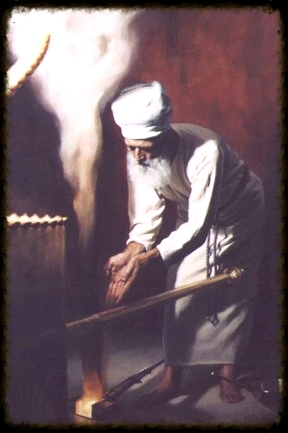
 

Vayakhel, Exodus 35:1-38:20

Link to Parsha: http://www.hebcal.com/sedrot/vayakhel

Mirror, Mirror on the Wall, Who’s the Fairest of Them All?

By Rabbi Laura Geller

This week’s Torah portion, Vayakhel , is very familiar because much in it repeats what we read several weeks ago. In the earlier portions, God commands Moses to erect a Mishkan,a portable sanctuary, with all the ritual objects furnishing it, the Ark, the menorah, the sinks for the priests to wash before they begin their daily tasks, and then gives detailed instructions about the priestly vestments.

In this week’s portion, the Torah tells us that the people did exactly as God commanded Moses. But instead of reporting: “And Moses did as God commanded,” the text provides another very detailed description of each of the objects and clothes, repeating with great specificity everything we’ve already heard. Dr. Carol Meyers labels the earlier instructions “prescriptive Tabernacle texts” because they prescribe what is to be done, while our portions, which describe the implementation of the instructions, are called “descriptive Tabernacle texts” (see The Torah: A Women’s Commentary,ed. Tamara Cohn Eskenazi and Andrea L. Weiss [New York: URJ Press, 2008], p. 521). What separates the two accounts is the sin of the Golden Calf.

Why does there need to be such detail? Maybe it is to reassure us that even after such an egregious sin as the idol worship of the Golden Calf, not only has God forgiven us, but also, we’ve finally gotten it right. We shouldn’t worship a golden idol, but we can use gold and other valuable resources to symbolize God’s presence among us through the Mishkan. And apparently we did, as we read: “. . . all the artisans who were engaged in the tasks of the sanctuary came . . . and said to Moses, ‘The people are bringing more than is needed for the task entailed in the work that YHVH has commanded to be done.’ Moses thereupon had this proclamation made throughout the camp: ‘Let no man or woman make further effort toward gifts for the sanctuary’ ” (Exodus 36:4–6).

But perhaps we are simply meant to learn that attention to detail is important. Anyone who has ever remodeled a home or redecorated a room knows how many details are involved: color, texture, shape, size, material, and so on.

There is one detail that I have always found fascinating. “He made the laver [sink] of copper and its stand of copper, from the mirrors [mar’ot] of the women who performed tasks at the entrance of the Tent of Meeting” (38:8). B’mar’ot hatzov’ot literally means “the mirrors of legions,” but as The Women’s Torah Commentary explains, because hatzov’ot is grammatically feminine, the text must be talking about women (see The Torah: A Women’s Commentary, p. 536).

Rashi, the famous eleventh century commentator, notices that only here in the whole story of the making of the Mishkan do we have an account of a specific gift and what it was used for. He imagines a dialogue between Moses and God:

“Mirrors?” Moses demands of God, “The women are bringing mirrors? How dare they bring these trinkets of vanity into a holy place? I forbid it! Mirrors just lead to lustful thoughts!”

But God intervenes: “Accept them, for these are more precious to me than anything because through them the women set up many legions [i.e., through the children they gave birth to] in Egypt.” When their husbands were weary from backbreaking labor, the women would go and bring them food and drink. Then the women would take the mirrors and each one would see herself with her husband in the mirror, and she would seduce him with words, saying, “I am more beautiful than you.” And in this way they aroused their husbands’ desire and would copulate with them, conceiving and giving birth there, as it is said: “Under the apple tree I aroused you” (Song 8:5). This is [what is meant by] that which is said, “with the mirrors of those who set up legions, that is, the mirrors of those who had lots of children” (see Rashi on Exodus 38:8).

Imagine what it must have been like for the Israelite men forced to do backbreaking, demeaning work. Their spirits were destroyed; they had lost all hope for the future. It was the women who kept the men’s will to live alive. Even in those horrible circumstances, the women would beautify themselves with the help of these mirrors, using makeup from with whatever dyes and rouges they could find, making themselves attractive to their partner. When the men came home, exhausted and dehumanized, their wives would arouse them by flirting, by playing erotic games, by looking with their husbands into the mirrors, by teasing “which one of us is more attractive?”

These women didn’t give up hope for a different future. They were responsible for our spiritual survival. It was their initiative, courage, and faith that led to the next generation. Perhaps because of that the Talmud tells us: “It was because of the righteousness of the women that we were redeemed from Egypt” (Babylonian Talmud, Sotah 11b).

That detail about the mirrors reminds us of the special role that women played in the liberation of our people.

Geller, Laura. "Mirror, Mirror on the Wall, Who's the Fairest of Them All?" ReformJudaism.org. (Viewed on February 22, 2014). http://www.reformjudaism.org/mirror-mirror-wall-who%E2%80%99s-fairest-them-all

Team-Building

By Rabbi Jonathon Sacks

How do you remotivate a demoralized people? How do you put the pieces of a broken nation back together again? That was the challenge faced by Moses in this week’s parsha.

The key word here is vayakhel, “Moses gathered.” Kehillah means community. A kehillah or kahal is a group of people assembled for a given purpose. That purpose can be positive or negative, constructive or destructive. The same word that appears at the beginning of this week’s parsha as the beginning of the solution, appeared in last week’s parsha as the start of the problem: “When the people saw that Moses was so long in coming down from the mountain, they gathered [vayikahel] around Aaron and said, ‘Make us a god to lead us. As for this man Moses who brought us up out of Egypt, we don’t know what has happened to him.’”

The difference between the two kinds of kehillah is that one results in order, the other in chaos. Coming down the mountain to see the golden calf, we read that “Moses saw that the people were running wild and that Aaron had let them get out of control and so become a laughingstock to their enemies.” The verb פרע, like the similar פרא, means “loose, unbridled, unrestrained.”

There is an assembly that is disciplined, task-oriented and purposeful. And there is an assembly that is a mob. It has a will of its own. People in crowds lose their sense of self-restraint. They get carried along in a wave of emotion. Normal deliberative thought-processes become bypassed by the more primitive feelings or the group. There is, as neuroscientists put it, an “amygdala hijack.” Passions run wild.

There have been famous studies of this: Charles Mackay’s Extraordinary Popular Delusions and the Madness of Crowds (1841), Gustave Le Bon’s The Crowd: a study of the popular mind (1895), and Wilfred Trotter’s Instincts of the Herd in Peace and War (1914). One of the most haunting works on the subject is Jewish Nobel prize-winner Elias Canetti’s Crowds and Power (1960, English translation 1962).

Vayakhel is Moses’ response to the wild abandon of the crowd that gathered around Aaron and made the golden calf (the building of the Tabernacle was, of course, God’s command, not Moses. The fact that it is set out as Divine command before the story of the Golden Calf is intended to illustrate the principle that “God creates the cure before the disease” (Megillah 13b)). He does something fascinating. He does not oppose the people, as he did initially when he saw the golden calf. Instead, he uses the same motivation that drove them in the first place. They wanted to create something that would be a sign that God was among them: not on the heights of a mountain but in the midst of the camp. He appeals to the same sense of generosity that made them offer up their gold ornaments. The difference is that they are now acting in accordance with God’s command, not their own spontaneous feelings.

He asks the Israelites to make voluntary contributions to the construction of the Tabernacle, the Sanctuary, the Mikdash. They do so with such generosity that Moses has to order them to stop. If you want to bond human beings so that they act for the common good, get them to build something together. Get them to undertake a task that they can only achieve together, that none can do alone.

The power of this principle was demonstrated in a famous social-scientific research exercise carried out in 1954 by Muzafer Sherif and others from the University of Oklahoma, known as the Robbers’ Cave experiment. Sherif wanted to understand the dynamics of group conflict and prejudice. To do so, he and his fellow researchers selected a group of 22 white, eleven-year-old boys, none of whom had met one another before. They were taken to a remote summer camp in Robbers Cave State Park, Oklahoma. They were randomly allocated into two groups.

Initially neither group knew of the existence of the other. They were staying in cabins far apart. The first week was dedicated to team-building. The boys hiked and swam together. Each group chose a name for itself – they became The Eagles and the Rattlers. They stencilled the names on their shirts and flags.

Then, for four days they were introduced to one another through a series of competitions. There were trophies, medals and prizes for the winners, and nothing for the losers. Almost immediately there was tension between them: name-calling, teasing, and derogatory songs. It got worse. Each burned the other’s flag and raided their cabins. They objected to eating together with the others in the same dining hall.

Stage 3 was called the ‘integration phase’. Meetings were arranged. The two groups watched films together. They lit Fourth-of-July firecrackers together. The hope was that these face-to-face encounters would lessen tensions and lead to reconciliation. They didn’t. Several broke up with the children throwing food at one another.

In stage 4, the researchers arranged situations in which a problem arose that threatened both groups simultaneously. The first was a blockage in the supply of drinking water to the camp. The two groups identified the problem separately and gathered at the point where the blockage had occurred. They worked together to remove it, and celebrated together when they succeeded.

In another, both groups voted to watch some films. The researchers explained that the films would cost money to hire, and there was not enough in camp funds to do so. Both groups agreed to contribute an equal share to the cost. In a third, the coach on which they were travelling stalled, and the boys had to work together to push it. By the time the trials were over, the boys had stopped having negative images of the other side. On the final bus ride home, the members of one team used their prize money to buy drinks for everyone.

Similar outcomes have emerged from other studies. The conclusion is revolutionary. You can turn even hostile factions into a single cohesive group so long as they are faced with a shared challenge that all can achieve together but none can do alone.

Rabbi Norman Lamm, former President of Yeshiva University, once remarked that he knew of only one joke in the Mishnah, the statement that “Scholars increase peace in the world” (Berakhot 64a). Rabbis are known for their disagreements. How then can they be said to increase peace in the world?

I suggest that the passage is not a joke but a precisely calibrated truth. To understand it we must read the continuation: “Scholars increase peace in the world as it is said, ‘All your children shall be learned of the Lord and great will be the peace of your children’ (Isaiah 54: 13). Read not ‘your children’ but ‘your builders.’” When scholars become builders they create peace. If you seek to create a community out of strongly individualistic people, you have to turn them into builders. That is what Moses did in Vayakhel.

Team-building, even after a disaster like the golden calf, is neither a mystery nor a miracle. It is done by setting the group a task, one that speaks to their passions and one no subsection of the group can achieve alone. It must be constructive. Every member of the group must be able to make a unique contribution and then feel that it has been valued. Each must be able to say, with pride: I helped make this.

That is what Moses understood and did. He knew that if you want to build a team, create a team that builds.

Sacks, Jonathon. "Team-Building." OrthodoxUnion.org. (Viewed on February 22, 2014). http://www.ou.org/torah/parsha/rabbi-sacks-on-parsha/team-building/

Ki Tissa, Exodus 30:11-34:35

Link to Parsha: http://www.hebcal.com/sedrot/kitisa

Transformative Power

By Rabbi Ismar Schorsch

The story is told about Franz Kafka that the last time he visited Berlin, he chanced upon a little girl in a park awash in tears.

When he inquired as to the reason for her distress, she sobbed that she had lost her doll. Compassionately, Kafka countered that not to be the case. The doll had merely gone on a trip and, in fact, Kafka met her as she was about to leave. He promised that if the little girl would return to the park the next day, he would bring her a letter from her doll. And so Kafka did for several weeks, arriving each morning at the park with a letter for his new friend.

As his tuberculosis worsened, Kafka decided to return to Prague where he would soon die at age 41, but not before buying the girl another doll. Along with the doll came a letter in which Kafka insisted that this was the doll that belonged to his friend. Admittedly, she looked different, but then on her long trip the doll had seen many remarkable sights and gone through many searing experiences. Life had changed her appearance. (Jack Wertheimer, ed., The Uses of Tradition, p. 279).

Of the many meanings in this profound parable I wish to focus on the most obvious: that a transformative experience alters us externally as well as internally. This is the point of the closing narrative of our parashah. The second time that Moses ascends Mount Sinai to get the Ten Commandments–that is after the debacle of the golden calf–the Torah uncharacteristically gives us a profusion of details. In contrast to the brevity of description pertaining to his first ascent (Exodus 19:18-25; 24:1-4;31:18), the Torah now divulges that Moses stayed atop the mountain for 40 days and 40 nights without eating a morsel of bread or drinking a sip of water (34:28).

The intensity of this experience of the divine sets Moses’ face aglow permanently, striking his people with fear. Thereafter, Moses would cover his face with a veil, except when he entered the Tent of Meeting to talk with God or when he addressed the nation (34:29-35).

This exceptional passage is marked by vocabulary equally rare. While the noun keren–meaning “horn”–shows up often in the Tanakh, the verb karan (same consonants), meaning “to emit rays,” appears only here. Hence the mistranslation by the Vulgate to the effect that Moses came down with horns, a sign of sanctity. Similarly the noun for “veil” masveh, is unique to our narrative. Clearly, subject and language join to underscore the impact on Moses of being in God’s presence for an extended period of time.

The description interfaces with two earlier passages. As the Israelites grow uneasy over the delay in Moses’ return from Mount Sinai the first time, they suspect that he is but an ordinary, fallible mortal (33:1). Aaron, on the other hand, who serves as the Tabernacles’ chief priest, is distinguished by his ornate vestments. The radiance on Moses’ face counters both perceptions. Transformed by his experience, Moses stands out among mortals, a leader without need of special garments. The visible manifestation of his inner state sets him apart from the ordinary or conventional.

The midrash imagines the change to have occurred in one of two ways. One view suggests that God actually touched Moses as he cowered in the crevice of the rock. It was literally God’s hand that shielded Moses as God passed by to give him a glimpse of the divine presence (33:22). The other conjectures that as God instructed Moses atop Mount Sinai, Moses absorbed some of the divine sparks that emanated from God’s mouth (Tanhuma, Ki Tissa, no. 37). Either way, whether by physical or spiritual means, the aftermath of the golden calf effected a lasting transformation in the appearance of Moses.

To be sure, the external is only a reflection of a reality that is internal. Is that not the mark of a great portrait painter like Rembrandt that he makes the face reveal the soul of his subject? Grace should be visible. Thus when we find ourselves in the presence of a truly great scholar of Torah we thank God in a berakhah for having endowed someone who fears God with divine wisdom. The labor of a lifetime exudes an aura of equanimity.

On a smaller scale, what happened to Moses is replicated in our own lives each week with the observance of Shabbat, a topic taken up twice in our parashah (31:12-16; 34:21). As the light radiating from Moses’ face attested to his relationship to God, so integrating Shabbat into the rhythm of our lives infuses an extrasensory dimension of existence into our being. Both are a sign signifying the convergence of the holy and profane, of that which is eternal and that which is passing.

Janus-like the Sabbath reminds us of the cataclysms by which God created the cosmos, even as it provides us a tad of a foretaste of the peacefulness that awaits us in the world-to-come. By expressing our reverence in rest, we gain a measure of renewal. The combination of prayer and study, of food, family and friendship imbues us with an expansion of spirit, a veritable extra soul that leaves us only as the Sabbath fades away.

But we enter the work week illuminated and restored with a touch of eternity to carry us through the ordeal of the mundane. At best, the spiritual respite has transfigured our demeanor, like Kafka’s doll.

Schorsch, Ismar. "Transformative Power." My Jewish Learning. (Viewed on February 15, 2014). http://www.myjewishlearning.com/texts/Bible/Weekly_Torah_Portion/kitissa_jts.shtml?p=0

One G-d?

By Elisha Ancselovitz

Living can be painful. Economies can collapse. Does it matter whether people believe in one G-d, multiple gods, or no G-d? Does it matter whether the Jews in this week’s Torah portion serve the G-d who speaks through Moses or the merely superior god of a pantheon who rides on a young bull (Exodus chapter 32)?

Let us begin answering this question by acknowledging that Jewish mysticism has included various imageries of a multi-personality G-d and that Jewish philosophy has included a G-d without a personality, and that some Jews have even believed in Satan’s free choice. More importantly, let us acknowledge that if G-d cared about correct theology for His own sake, G-d would no longer be good, as in one who acts for the sake of others. In other words, let us begin answering by acknowledging that theology cannot be important for its own sake.

If theology is not important for its own sake, our other option for understanding the problematic of idolatry is to examine what G-d in Tanach ultimately desires of humans (however we imagine that G-d), to discover the contra to idolatry. In answer to that question, we turn to the three explicit prophetic statements of G-d’s desire. Each prophet states in oratorical parallelism that G-d desires goodness:

The first is: “He has told you, O man, what is good. And what does the Eternal require of you other than to act justly and to love mercy and to walk humbly with your G-d?” (Micah 6:8) The second is: “Let him who boasts boast about this: that he understands and knows me as the Eternal who exercises kindness, justice and righteousness on earth. For these things I desire, declares the Eternal.” (Jeremiah 9:24) The third is: “For I desire kindness and not sacrifice Knowing [or Internalizing] G-d over burnt offerings.” (Hoseah 6:6)

According to the prophets, the point is to live with one solitary G-d, an underlying source of reality that is Goodness and calls for Goodness. Sometimes we will find ourselves in a period of Revelation and we will hear and see G-d in thunder and lightning (Exodus 20:14). Sometimes, with a blink of an eye, we will feel ourselves abandoned in the desert, like the Israelites this week. Other times, we will find ourselves in a world of evil like Elijah the prophet, and we will not find G-d in powerful manifestations but rather in a thin silent voice:

“…Then a very strong – mountain and stone shattering before the Eternal – wind blew, but the Eternal was not in the wind. After the wind, there was an earthquake, but the Eternal was not in the earthquake. After the earthquake, there was a fire, but the Lord was not in the fire. After the fire, there was a quiet, gentle sound.” (1 Kings 19:12-13)

No matter what manifestation of G-d we experience and in whatever theological form, the Biblical commandment is to connect with and express the reality of Go[o]d[ness].

Ancselovitz, Elisha. "Ki Tissa 5769." Limmud On One Leg. (Viewed February 15, 2014). http://limmud.org/publications/limmudononeleg/5769/ki-tissa/

Tetzaveh, Exodus 27:20-30:10

Link to Parsha: http://www.hebcal.com/sedrot/tetzaveh

Dvar Tzedek

By Jonathon Soffer

Now that the Exodus narrative is over, the gripping accounts of our ancestors that pervaded the first two books of the Torah fade into distant memory and we begin reading the detailed guidelines for the construction and use of the Mishkan, the Tabernacle. While initially many of these details seem extraneous or irrelevant, they contain within them deep wisdom and insight into our lives and moral obligations as Jews.

The korban tamid, the continual offering, described in Parashat Tetzaveh, is a compelling example of the deep symbolic meaning that can be found in the details of ritual. Before the episode of the Golden Calf, God gives the commandment to offer the tamid: “Now this is what you shall offer upon the altar—two yearling lambs each day, regularly. […] It shall be a continual burnt-offering throughout your generations at the door of the tent of meeting before God, where I will meet with you, to speak there to you.”

On the surface, it appears that the korban tamid was a simple, perfunctory sacrifice, offered twice daily. Several commentators, however, suggest that the ritual contains important spiritual lessons. The Abarbanel, a 15th-century Portuguese Torah scholar, explains that we offer the tamid twice daily to correspond to the dual physical and spiritual freedoms which God provided by freeing us from slavery in Egypt, and engaging us in an eternal covenant at the revelation at Sinai.

The Maharal, Rabbi Judah Loew ben Bezalel, a prominent 16th-century mystic and Torah scholar, brings a remarkable anecdote in the introduction to his ethical work, the Netivot Olam, which looks at the tamid from another perspective:

Shimon ben Pazzai comes and says there is a verse that is even more significant and more meaningful and more inclusive than either of these two verses [referring to the Shma, and the commandment to love your neighbor]. What is the verse? ”And the one lamb you shall make in the morning.”

In this text, the Rabbis are debating which is the most fundamental sentence in the Torah. The first two suggestions—the Shma and the ‘love one’s neighbor’—are predictable and appropriate possibilities. The third option, “and the one lamb you shall make in the morning,” refers to thekorban tamid. This seems strange. What is the allure of this passuk that it could be the most important sentence in the Torah?

The Maharal, in elaborating on this ostensibly bizarre choice, suggests that this quote speaks to the need for consistent commitment and constant engagement in Jewish life. The korban tamid is so important because, as a sacrifice conducted every single day, it symbolizes our unwavering commitment to living a life replete with Yiddishkeit, without which other commandments become meaningless or irrelevant.

According to this perspective, a living Judaism cannot be limited to sporadic rites or cultural practice; it must be something that infuses our daily lives. Though not everyone’s Judaism needs to be identical (indeed, one of the glories of Judaism is the divergence of our expressions), any expression of Judaism should be perpetual. We need our tamid—an involvement that, in its own way, is shown daily.

While this message is personally relevant to me in the realm of traditional ritual observance, I believe that it issues a call in the realm of ethical mitzvot, as well. The Torah commands us to help people in need, to protect the widow and the defenseless and to empower the most marginalized. The tamid reminds us that these actions cannot be intermittent initiatives, but must instead be persistent features of our Jewish lives and identity. Every day we must strive to perfect this world, in the kingdom of Shadai [God].

The challenge is to find the constant inspiration and motivation to foster perpetual involvement. In the absence of the daily korban tamid, what can remind and encourage us to achieve a constant and consistent commitment to the ethical obligations of Judaism? Parashat Tetzaveh begins with another “tamid” (constant) which can serve in this role. The ner tamid, the eternal light, which still shines above the Holy Ark in our synagogues today, is a reliable reminder of our Ultimate responsibilities. In particular, this visual symbol can help us remember our responsibilities to respond to injustices in the developing world, which are sadly so often “out of sight, out of mind.” As we read the holy words of this parashah, it is our task to find our tamid—the eternal reminder of our Eternal calling.

Soffer, Jonathan. "Dvar Tzedek." American Jewish World Service. (Viewed on February 8, 2014). http://ajws.org/what_we_do/education/publications/dvar_tzedek/5774/tetzaveh.html

Incense

Tetzaveh 5774

By Joanna Bruce

At the end of this week’s portion, following the many intricate descriptions of the priests’ clothing and the even more specialised garments of the High Priest, we are led on an interesting detour into an account of the altar for the burning of incense.

1) You shall make an altar for bringing incense up in smoke; … 6) And you shall place it in front of the dividing curtain, which is upon the Ark of Testimony, in front of the ark cover, which is upon the testimony, where I will arrange to meet with you. (Exodus 30:1, 6)

This section seems out of place. It would make far more sense for this account to be placed when all the other artifacts used in the Temple service were described in last week’s portion. Why is the incense altar described here completely out of context?

The items described last week such as the Ark, Menorah, Table etc. seem to have a unity of purpose, one way or another they are all about revealing God and strengthening our connection to Him.

God commands Moses to ‘make me a house so I may dwell in it’ (Exodus 25:8) and the Menorah and the Table can be understood at its furniture, the offerings given on the altar are our house warming gifts. Is the incense offering so different? Is it not the potpourri or the smell of fresh coffee or baking bread? The smells that make us feel at home.

The fact that it has been placed in a separate section of the Torah would indicate that its function was connected with the Temple but has a different purpose from the other holy objects.

The function of the sacrifices in the Temple was as a vehicle for communication between the people and God. The people would ‘offer’ something of themselves either as a collective, in the form of a daily offerings, or as individuals when bringing a sin offering. This was our conversation with God, “I’m sorry”; “Thank you”, “Please help” and God’s reply was in the miraculous acceptance of the sacrifice.

The incense has a very different purpose. The incense was offered to God at the very heart of the Temple, right in front of the Holy of Holies where the Ark was kept. On Yom Kippur the ceremony went literally one step further and was given in the Holy of Holies itself. The incense would create a cloud of smoke that obscured the curtain and on Yom Kippur would fill the Holy of Holies.

Its purpose was to conceal rather than reveal, to create a distance between God and humanity rather than connection. It is the diametric opposite to all those other objects and ceremonies in the Temple and it is for this reason that it is described in a different place.

Concealment seems to be a necessary component of our relationship with God. There is an element of the Unknown and the Unknowable about God that is important and fundamental. The uncertainty that concealment creates is the basis of our capacity of free choice, when we choose to know and follow God we are overcoming the doubts we have because things are not perfectly clear. But our commitment is all the greater because we had to overcome that challenge.

Bruce, Joanna. "Tetzaveh 5774." Limmud. (Viewed on February 8, 2014). http://limmud.org/publications/limmudononeleg/5774/tetzaveh/

Terumah, Exodus 24:1-27:19

Link to Parsha: http://www.hebcal.com/sedrot/terumah

A Representation of the Mishkan

Mishkan

Parshah In-Depth

By The Lubavitcher Rebbe

The Ark containing the “Tablets of the Law” was the most secluded of the Mishkan’s vessels, hidden away in its innermost chamber, the “Holy of Holies.” This expresses the ideal that the Torah scholar (who serves as an “Ark” for the Torah) must remove himself from all worldly endeavors. At the same time, the Ark was also the most “portable” of the Tabernacle’s vessels. The Torah decrees that, “The carrying poles shall be in the rings of the Ark; they shall never be removed” (Exodus 25:15) — a law which applies exclusively to the Ark. If there is a soul somewhere in the ends of earth thirsting for the word of G-d, the Torah scholar must be prepared to leave his sanctum to transport the Torah to that place. Even as he sits in his “Holy of Holies,” he must be always at the ready to venture out, constantly aware of his responsibilities toward the world outside.

The Lubavitcher Rebbe. "Parshah In-Depth: From Our Sages." Chabad. (Viewed on February 1, 2014). http://www.chabad.org/parshah/in-depth/default_cdo/aid/36471/jewish/In-Depth.htm

Dvar Tzedek

By Evan Wolkenstein 

In Parashat Terumah, the Israelites receive the blueprints for a majestic tent—the mishkan—that will eventually house the magnificent Ark of the Covenant. As we read the vivid description, we can picture its grandeur. During the Israelites’ journeys through the desert, the mishkan serves as a portable temple, with the home of God’s indwelling, the Ark, at its center. The Israelite tribes camp around it, placing it at the heart of the nation.

While the detailed beauty of the Ark sounds stunning, the medieval commentator Abravanel wonders about its design. The first of the Divine Laws prohibits graven images of any kind, replications of any being, heavenly or earthly. But upon the cover of the ark perch two cherubim, winged human forms. It would seem that by including these forms, God is breaking God’s own Law.

There is a possible resolution to this seeming contradiction in the very details of space and shape that make this parashah and its focus on design so fascinating. “From above the cover,” says God, “from between the two cherubim that are on top of the Ark of the Covenant,” God will meet with humanity. The voice of God emerges not from the mouth of any graven image, but from the empty space between two faces.

From the place of human encounter emerges the Divine Voice. Certainly, in every act of true listening, of honest speaking, and thus in every act of compassion, in every heartfelt encounter, in every ethical interaction we can hear God’s voice. In other words, if idolatry is to hear the voice of God emerging from a block of gold, then the opposite of idolatry is to see God’s face in every human being, to hear God’s voice emerging from the relationship of any two beings, face to face, eye to eye, ish el achiv—from one person to another.

Yet the presence of the sacred in human interactions does not occur automatically in the encounter. There is a crucial foundation upon which this relationship takes place, a vital basis where our relationships must be rooted.

Taking a closer look at who or what resides in the mishkan, we find that God is not, in fact, the tent’s primary resident. Rather, at the center of this sacred structure is the Law—the two stone tablets chiseled during Revelation at Sinai, when the human and heavenly worlds met. Though the tablets contain only ten laws, they are the symbol of the covenantal relationship that guides Israel’s every behavior. The five laws on the right-hand tablet guide us in the realm ofben adam l’Makom—between humans and the Omnipresent—and the five laws on the left-hand tablet guide us in the realm of ben adam l’chavero—between humans and their brethren. In that sense, the core of the mishkan is a monument to Divine ethical vigilance. The Ark, then, is not a platform for God crowned by two idols, but a complex model for Divine relationship. God dwells among us when we build relationships that are founded on morality and focused on the encounter.

The mishkan, likewise, is a model. The Ark sits at its core, representing righteous relationship, and the mishkan places this relationship in the context of a building, an institution. For the nascent nation of Israel, the mishkan was not only the site of religious service, but also the seat of legislation, of conflict resolution and even of the military. It is not enough to strive for correct relationships one-on-one or even within our own homes—the mishkan challenges us to build our most important institutions in this same model.

To actualize its lesson, we must demand of our own governments an equivalent commitment to both the human encounter and the ethical foundations upon which it must rest. The parashah’s attention to detail speaks to the kind of vigilance our own society must have, ensuring that this ethical-relational commitment is present in our governing structures at all levels, in every aspect. We must use this as our model for the way elections are carried out, the way checks and balances are calculated, the commitment to truthful reports in all public communications and the way domestic and international policies are developed and implemented. All systems should exemplify this commitment, ensuring the safety, freedom and dignity of all people.

We invoke the mishkan by studying it, by building our world in its image. By choosing to adopt its particular architectural style and the values that it embodies, we make ourselves in the image of the Master Architect.

Wolkenstein, Evan. "Dvar Tzedek: Parashat Terumah 5774." American Jewish World Service. (Viewed on February 1, 2014). http://ajws.org/what_we_do/education/publications/dvar_tzedek/5774/terumah.html

Mishpatim, Exodus 21:1-24:18

Link to Parsha: http://www.hebcal.com/sedrot/mishpatim

We Are The Narrative

By Rabbi Dianne Cohler-Esses

Every year at this time it happens: I become disappointed in the Torah.

Thunder and lightning and voices of revelation at Sinai are followed by the plodding specificity of the civil and religious laws of Mishpatim. The Torah goes from narrative to endless laws and detailed instructions for a good portion of the remainder of the five books.

Going from Yitro to Mishpatim we come down the mountain with a real thud. Gone are the salacious family stories of Genesis and the dramatic national birth story of Exodus. Starting with this week’s parashah, sitting in synagogue week after week, one can hear yawns all around. What happened to the joy of sheer story? Why do we move from aggadah (narrative) to halakhah (law)?

To complicate matters further: after all the suffering of the Israelites in Egypt, the very first laws of Mishpatim concern slave ownership. Not the prohibition of owning slaves, as one might want and expect, but the rules detailing the treatment of a slave, slavery an institution that is simply presumed by the text. After all that, after all those years enslaved, after witnessing the plagues, after passing through the red sea to escape slavery, why in the world are the Israelites permitted the ownership of other human beings?

One can understand this shift from Sinai to laws concerning slavery in two interrelated ways:

Misphatim begins with the following law: “When you acquire a Hebrew slave, he shall serve six years; in the seventh year he shall go free.” (Exodus 21:2)

It’s almost as if they are given a law in which they are commanded to transform, to revolutionize their own consciousness. You can own a slave, but after seven years, you must set that slave free. You were a slave, and now you will be a master. And as a master you must liberate. As God liberated you, so must you set your slave free–a clear example of tzelem elokim (being created in the image of God), or to put it another words, imatatio dei (the imitation of God).

The shift from narrative to law begins to have meaning in the context of this same shift of power. Until this point in the text we are told a story. We are watching these events happen to others. But, where story becomes law we are told how to live our lives. We are supremely implicated.

The very first law captures the story that the Israelites had just experienced, and yet, at the same point tells them to take control of that narrative and perform it themselves–perform exodus, perform liberation. You may be masters, but you must become liberators. Every seven years.

Indeed, the narrative that frames and shapes these laws, the narrative that gives these legal details coherence, is the narrative of liberation.

Consider for example the following verses:

“You shall not wrong a stranger or oppress him, for you were strangers in the land of Egypt” (Exodus 22:20) and “You shall not oppress a stranger, for you know the feelings of the stranger, having yourselves been strangers in the land of Egypt” (Exodus 23:9).

This is what happened to the narrative. It didn’t disappear. Rather, shifting from narrative to law shifts the very nature of the text’s address. Beforehand we were reading a story that happened to others in history. Now I read the text, and I am commanded to become an actor and to act in a certain way. A way that liberates.

If I become the subject of these laws, the story doesn’t end at all. It’s just that I, the reader, I, the one addressed by this sacred text, am now at the very center of the story. It’s supremely personal. For much of the rest of the Bible we can no longer escape into a good story, because that story has become all about us. There is no escape, only exodus. Exodus and liberation. And the endless multiplying of story.

Cohler-Esses, Dianne. "We Are the Narrative." My Jewish Learning. (Viewed on January 25, 2014). http://www.myjewishlearning.com/texts/Bible/Weekly_Torah_Portion/mishpatim_bronfman.shtml?p=0

The Slow End of Slavery

By Rabbi Jonathon Sacks

In parshat Mishpatim we witness one of the great stylistic features of the Torah, its transition from narrative to law. Until now the book of Exodus has been primarily narrative: the story of the enslavement of the Israelites and their journey to freedom. Now comes detailed legislation, the “constitution of liberty.”

This is not accidental but essential. In Judaism, law grows out of the historical experience of the people. Egypt was the Jewish people’s school of the soul; memory was its ongoing seminar in the art and craft of freedom. It taught them what it felt like to be on the wrong side of power. “You know what it feels like to be a stranger,” says a resonant phrase in this week’s parsha (23: 9). Jews were the people commanded never to forget the bitter taste of slavery so that they would never take freedom for granted. Those who do so, eventually lose it.

Nowhere is this clearer than in the opening of today’s parsha. We have been reading about the Israelites’ historic experience of slavery. So the social legislation of Mishpatim begins with slavery. What is fascinating is not only what it says but what it doesn’t say.

It doesn’t say: abolish slavery. Surely it should have done. Is that not the whole point of the story thus far? Joseph’s brothers sell him into slavery. He, as the Egyptian viceroy Tzofenat Paneach, threatens them with slavery. Generations later, when a pharaoh arises who “knew not Joseph,” the entire Israelite people become Egypt’s slaves. Slavery, like vengeance, is a vicious circle that has no natural end. Why not, then, give it a supernatural end? Why did God not say: There shall be no more slavery?

The Torah has already given us an implicit answer. Change is possible in human nature but it takes time: time on a vast scale, centuries, even millennia. There is little doubt that in terms of the Torah’s value system the exercise of power by one person over another, without their consent, is a fundamental assault against human dignity. This is not just true of the relationship between master and slave. It is even true, according to many classic Jewish commentators, of the relationship between king and subjects, rulers and ruled. According to the sages it is even true of the relationship between God and human beings. The Talmud says that if God really did coerce the Jewish people to accept the Torah by “suspending the mountain over their heads” (Shabbat 88a) that would constitute an objection to the very terms of the covenant itself. We are God’s avadim, servants, only because our ancestors freely chose to be (see Joshua 24, where Joshua offers the people freedom, if they so chose, to walk away from the covenant then and there).

So slavery is to be abolished, but it is a fundamental principle of God’s relationship with us that he does not force us to change faster than we are able to do so of our own free will. So Mishpatim does not abolish slavery but it sets in motion a series of fundamental laws that will lead people, albeit at their own pace, to abolish it of their own accord. Here are the laws:

“If you buy a Hebrew servant, he is to serve you for six years. But in the seventh year, he shall go free, without paying anything . . . But if the servant declares, ‘I love my master and my wife and children and do not want to go free,’ then his master must take him before the judges. He shall take him to the door or the doorpost and pierce his ear with an awl. Then he will be his servant for life. (Ex. 21: 2-6)

What is being done in these laws? First, a fundamental change is taking place in the nature of slavery. No longer is it a permanent status; it is a temporary condition. A Hebrew slave goes free after seven years. He or she knows this. Liberty awaits the slave not at the whim of the master but by divine command. When you know that within a fixed time you are going to be free, you may be a slave in body but in your own mind you are a free human being who has temporarily lost his or her liberty. That in itself is revolutionary.

This alone, though, was not enough. Six years are a long time. Hence the institution of Shabbat, ordained so that one day in seven a slave could breathe free air: no one could command him to work:

Six days you shall labor and do all your work, but the seventh day is a sabbath to the Lord your God. On it you shall not do any work, neither you . . . nor your male or female servant . . . so that your male and female servants may rest, as you do. Remember that you were slaves in Egypt and that the Lord your God brought you out of there with a mighty hand and an outstretched arm. That is why the Lord your God has commanded you to observe the Sabbath day. (Deut. 5: 12-14)

But the Torah is acutely aware that not every slave wants liberty. This too emerges out of Israelite history. More than once in the wilderness the Israelites wanted to go back to Egypt. They say: “We remember the fish we ate in Egypt at no cost—also the cucumbers, melons, leeks, onions and garlic” (Num. 11: 5). As Rashi points out, the phrase “at no cost” [chinam] cannot be understood literally. They paid for it with their labour and their lives. “At no cost” means “free of mitzvot,” of commands, obligations, duties. Freedom carries a highest price, namely, moral responsibility. Many people have shown what Erich Fromm called “fear of freedom.” Rousseau spoke of “forcing people to be free” – a view that led in time to the reign of terror following the French revolution.

The Torah does not force people to be free but it does insist on a ritual of stigmatization. If a slave refuses to go free, his master “shall take him to the door or the doorpost and pierce his ear with an awl.” Rashi explains:

Why was the ear chosen to be pierced rather than all the other limbs of the body? Said Rabbi Yochanan ben Zakkai: …The ear that heard on Mount Sinai: “For to Me are the children of Israel servants” and he, nevertheless, went ahead and acquired a master for himself, should [have his ear] pierced! Rabbi Shimon expounded this verse in a beautiful manner: Why are the door and the doorpost different from other objects of the house? G-d, in effect, said: “The door and doorpost were witnesses in Egypt when I passed over the lintel and the two doorposts, and I said: ‘For to me are the children of Israel servants’ ” —they are My servants, not servants of servants, and this person went ahead and acquired a master for himself, he shall [have his ear] pierced in their presence.

A slave may stay a slave but not without being reminded that this is not what God wants for His people. The result of these laws was to create a dynamic that would in the end lead to an abolition of slavery, at a time of free human choosing.

And so it happened. The Quakers, Methodists and Evangelicals, most famous among them William Wilberforce, who led the campaign in Britain to abolish the slave trade were driven by religious conviction, inspired not least by the biblical narrative of the Exodus, and by the challenge of Isaiah “to proclaim freedom for captives and for prisoners, release from darkness” (Is. 61: 1).

Slavery was abolished in the United States only after a civil war, and there were those who cited the Bible in defence of slavery. As Abraham Lincoln put it in his second Inaugural: “Both read the same Bible and pray to the same God, and each invokes His aid against the other. It may seem strange that any men should dare to ask a just God’s assistance in wringing their bread from the sweat of other men’s faces, but let us judge not, that we be not judged.”

Yet slavery was abolished in the United States, not least because of the affirmation in the Declaration of Independence that “all men are created equal,” and are endowed by their Creator with inalienable rights, among them “life, liberty and the pursuit of happiness.” Jefferson, who wrote those words, was himself a slave-owner. Yet such is the latent power of ideals that eventually people see that by insisting on their right to freedom and dignity while denying it to others, they are living a contradiction. That is when change takes place, and it takes time.

If history tells us anything it is that God has patience, though it is often sorely tried. He wanted slavery abolished but he wanted it to be done by free human beings coming to see of their own accord the evil it is and the evil it does. The God of history, who taught us to study history, had faith that eventually we would learn the lesson of history: that freedom is indivisible. We must grant freedom to others if we truly seek it for ourselves.

Sacks, Jonathon. "The Slow End of Slavery." OU Torah. (Viewed on January 25, 2014). http://www.ou.org/torah/article/the_slow_end_of_slavery#.UuUIsdLFLDc

Yitro, Exodus 18:1-20:23

Link to Parsha: http://www.hebcal.com/sedrot/yitro

Women and Revelation

By Judith Plaskow

Read from a feminist perspective, Yitro contains one of the most painful verses in the Torah. At the formative moment in Jewish history, when presumably the whole people of Israel stands in awe and trembling at the base of Mount Sinai waiting for God to descend upon the mountain and establish the covenant, Moses turns to the assembled community and says, “Be ready for the third day: do not go near a woman” (19:15). Moses wants to ensure that the people are ritually prepared to receive God’s presence, and an emission of semen renders both a man and his female partner temporarily unfit to approach the sacred (see Leviticus 15:16-18). But Moses does not say, “Men and women do not go near each other.” Instead, at this central juncture in the Jewish saga, he renders women invisible as part of the congregation about to enter into the covenant.

These words are deeply troubling for at least two reasons. First, they are a paradigm of the treatment of women as “other,” both elsewhere in this portion and throughout the Torah. Again and again, the Torah seems to assume that the Israelite nation consists only of male heads of household. It records the experiences of men, but not the experiences of women. For example, the tenth commandment, “You shall not covet your neighbor’s wife” (20:14), presupposes a community of male hearers.

Second, entry into the covenant at Sinai is not just a one-time event, but an experience to be reappropriated by every generation (Deuteronomy 29:13-14). Every time the portion is chanted, whether as part of the annual cycle of Torah readings or as a special reading for Shavuot, women are thrust aside once again, eavesdropping on a conversation among men, and between men and God. The text thus potentially evokes a continuing sense of exclusion and disorientation in women. The whole Jewish people supposedly stood at Sinai. Were we there? Were we not there? If we were there, what did we hear when the men heard “do not go near a woman”? If we were not there originally, can we be there now? Since we are certainly part of the community now, how could we not have been there at that founding moment?

Given the seriousness of these questions, it is important to note the larger narrative context of Moses’ injunction to the men not to go near a woman. When the Israelites arrive at Sinai on the third new moon after leaving Egypt, Moses twice ascends the mountain to talk with God. After he brings God the report that the people have agreed to accept the covenant, God gives Moses careful instructions for readying everyone for the moment of revelation: “Go to the people and warn them to stay pure today and tomorrow,” God says. “Let them wash their clothes. Let them be ready for the third day; for on the third day Adonai will come down, in the sight of all the people, on Mount Sinai” (19:10-11). It is striking that God’s instructions to Moses are addressed to the whole community. It is Moses who changes them, who glosses God’s message, who assumes that the instructions are meant for only half the people. Thus, at this early stage in Jewish history, Moses filters and interprets God’s commands through a patriarchal lens. His words are a paradigm of the treatment of women, but a complex one. They show how Jewish tradition has repeatedly excluded women, but also the way in which that exclusion must be understood as a distortion of revelation.

Interestingly, the Rabbis seem to have been disturbed by the implication of women’s absence from Sinai, because they read women into the text in a variety of ways. B’reishit Rabbah 28:2 understands Exodus 19:3 (“Thus shall you say to the house of Jacob and declare to the children of Israel”) to mean that “the house of Jacob” refers to the women and “the children of Israel” refers to the men. According to the midrash, the order of the verse suggests that God sent Moses to the women with the Torah first. Perhaps, the sages speculate, God regretted the mistake of not directly giving Eve the commandment concerning the forbidden fruit and so resolved not to repeat it. Besides, the Rabbis note, women are more careful in observing religious precepts, and they are the ones who will instruct their children. Rashi, commenting on the Mishnah (Shabbat 9:3; BT Shabbat 86a), interprets Exodus 19:15 (“Do not go near a woman”) as a stricture specifically designed to enable Israel’s women to be present at Sinai. Since semen loses its power to create impurity after three days, Moses’ instruction to the men guarantees that women will remain ritually pure, even if they discharge residual semen during the Revelation. In other words, without ever naming Moses’ distortion of God’s words directly, the Rabbis sought to reverse its effects.

Several lessons can be drawn from this. One is the inseparability of revelation and interpretation. There is no revelation without interpretation; the foundational experience of revelation also involves a crucial act of interpretation. Second, we learn that the process of interpretation is ongoing. What Moses does, the Rabbis in this case seek to undo. While they reiterate and reinforce the exclusion of women in many contexts, they mitigate it in others. Third, insofar as the task of interpretation is continuing, it now lies with us. If women’s absence from Sinai is unthinkable to the Rabbis–despite the fact that they repeatedly reenact that absence in their own works–how much more must it be unthinkable to women and men today who function in communities in which women are full Jews? We have the privilege and the burden of recovering the divine words reverberating behind the silences in the text, recreating women’s understandings of revelation throughout Jewish history.

Plaskow, Judith. "Women and Revelation." My Jewish Learning. (Viewed January 18, 2014). http://www.myjewishlearning.com/texts/Bible/Weekly_Torah_Portion/URJ--Yitro.shtml?p=0

Not Norms for Everyone

By Jon D. Levenson

The Decalogue [the Greek word for the Ten Commandments] is part of a specific covenantal relationship, born out of the Exodus, between God and Israel. It does not purport to be a set of universal norms. To act as if everybody in the world came out of Egypt, everyone in the world is required to observe Shabbat and everyone in the world was brought into the land of Israel would make a travesty of the actual biblical narrative. The truth is that neither biblical nor rabbinic traditions speak of the Decalogue as applicable to universal humanity. In rabbinic tradition, there is a universal set of norms, but it is the “Seven Noahide Commandments.” Among different Christian communities, the understanding of the Ten Commandments varies widely. Sometimes they are seen to include ceremonial norms that applied to the ancient Hebrew commonwealth but were superseded by the Gospel, but other times they are thought to apply in full force to Christians today. Given the prominence of Protestantism, and especially the Calvinist emphasis on the Old Testament in American culture, it is not surprising that the Decalogue has widespread significance and high prestige here. It is often mistakenly detached from its covenantal framework and treated instead as a code that binds society as a whole. Within the covenantal relationship between God and the Jewish people, of course, scrupulous observance of the Decalogue remains essential.

Levenson, Jon D. "Not Norms for Everyone." Excerpt from 10 Commandments 2.0 by Joan Alpert. Moment Magazine. (Viewed on January 18, 2014). http://www.momentmag.com/10-commandments-2-0/3/

B’Shalach, Exodus 13:17-17:16

Link to Parsha: http://www.hebcal.com/sedrot/beshalach

The Long Short-Cut

By Rabbi Ari Kahn

When the Israelites finally leave Egypt, rather than taking them on the shortest, most direct route to their destination, God leads them on a circuitous path. The trip eventually becomes so long that almost an entire generation passes away and the overwhelming majority of the adults who leave Egypt never make it to the Promised Land. One might be tempted to regard this entire venture as a failure. However, at the very start of the journey, the Torah tells us that God took them on this longer route because they did not have the moral fortitude to take the shorter route.

Perhaps it is human nature that makes detours infuriating; any trip that takes longer than scheduled can make us bristle. Maybe we are hardwired to want to shorten our travels, and arrive at our destination in as short a time as possible. For most of us, the only thing better than arriving on time is finding a shortcut and arriving early, especially when we are going home.

But travel is not always about geography, about movement from one place to another; travel is not only result-oriented. Sometimes the places, experiences and people we meet along the way are really the point of the trip. Sometimes the journey is not about the destination, but rather the growth experienced along the way.

The Israelites had been thrust into freedom, but the generations of slavery had limited and stifled them in so many ways, “relieving” them of the burden of independent thought and initiative. Incongruously, slaves and prisoners often create a “comfort zone” of rote functionality. Their lack of freedom can become like a womb or a cocoon, limiting yet sustaining. Without exercise, innate creativity and even the instinct for self-preservation become dull. People who become accustomed to having their basic needs taken care of by their captors or masters quickly lose the ability to take responsibility for their own lives. This is not a mass occurrence of Stockholm syndrome, in which the slaves identify with their oppressors. The dynamic is far more subtle: Slaves quickly “learn their place”, and begin to believe that this is their fate. In a certain sense, they are liberated from the burden of providing for their own needs and mastering their own fates. The security of the present – even an oppressive present – often outweighs the frightening prospect of the unknown, of the uncharted road to freedom and independence.

Had the Israelites taken the direct route to the Promised Land, they would have faced war, on the one hand, and economic independence on the other. They were neither physically, emotionally nor spiritually prepared for either, as is evidenced by their recurring bouts of nostalgia for the “good old days in Egypt.”Their long, circuitous journey through the desert, then, was an educational and spiritual process of growth. In the course of their travels, they would reexamine their dependency.Their most basic needs would become acute, pressing, in a new and alarming way, and they would learn to turn to God, and not to Pharaoh, as the ultimate Provider and Sustainer.

God knew that these newly-freed slaves were not yet capable of providing for themselves. Their spiritual and physical capabilities required nurturing. In the desert, they would develop a unique and intimate relationship with God, while at the same time evolving from a rag-tag band of emancipated slaves to a nation capable of defending itself and its right to exist and control its own destiny. For this to happen, the journey would have to be long and the pace slow but deliberate. They would be given commandments, but they would slowly assume responsibility for fulfilling those commandments over time. At the point of the Exodus, they were physically and emotionally exhausted; they had been enslaved and abused for hundreds of years. Had God not intervened, Pharaoh would not have granted them even the three-day vacation Moshe had requested on their behalf. They were in no fit state to carry all of the burdens of independence. Thus, while they would be granted the Sabbath – a revolutionary concept for the slave mentality -God knew they were not really ready for the six-day working week. They would have to learn about the true source of their sustenance without the physical labor of agrarian life in their homeland.

For that generation, then, the message of Shabbat was learned when on the seventh day they did not collect the manna/bread that fell from heaven throughout the week. Their “work”would be minimal,but the thrust of the lesson – that sustenance comes from God and not Pharaoh –would be clear and unmistakable nonetheless. The spiritual reality they experienced in the desert would achieve an even higher level on Shabbat by the simple cessation of activity, in imitation of God.

This was one of the many lessons they learned on the road, a lesson independent of their ultimate destination;the journey itself would teach them so many more invaluable lessons. The longer, less direct route would allow them to grow in so many ways, while the shorter route would have brought them to their destination long before they were ready to meet the challenges that awaited them there, long before they would truly be worthy of the inheritance that awaited them at the journey’s end. Perhaps the same holds true for our personal journeys in life: The path we take, and the lessons we learn along the way, are often no less important than the destination.

Kahn, Ari. The Long Shortcut. OU Torah. (Viewed on January 11, 2014). http://www.ou.org/torah/article/the_long_shortcut#.UtMzmNJdWqg

Contemporary Reflection on Parashat B’Shalach

By Rabbi Patricia Karlan-Newmann

There are moments that define us: unexpected or unplanned moments when the decisions we make, the actions we take, determine all that will follow. Crossroads come disguised in many forms. Many are unmarked, without a hint of what is ahead.

B’shalach describes such a crossroads. The crossing of the Sea of Reeds was not only the crossing out of Egypt and out of slavery, but also the entrance into an unknown future, made possible by a moment of extraordinary faith.

As she emerges from the water, Miriam faces an array of alternatives-an internal sea crossing of her own. Was it the time to forge ahead, adrenaline still coursing from their narrow escape? Was it the occasion to mourn the loss of the known, the familiar if oppressive Egypt? Was it the instant to comfort those catching their breath, those who had needed to run and swim faster than they believed possible? Was it safer to hang back and let others take their rightful place as leaders? Or was this the moment to lift up the hand-drum and triumphantly sing and dance, giddy with gratitude for God’s redemption?

Miriam had the foresight to bring her hand-drum. Miriam had the wisdom to gather her sisters to acknowledge and affirm the miracle, to mark the moment when their tenuous hope broke forth in joy the birth of her community as a people touched by God.

Miriam’s leadership is surprising. Kol ishah, the voice of a woman, Miriam’s strong voice, had been heard previously only as a sister and daughter. Yet, at her sea crossing, emerging from the waters, she does not wait for someone else to change the world. She does not demur that she was not bred for greatness. She does not blend into the crowd. Instead, Miriam’s voice rings out for all to hear.

Miriam is a leader: a prophet who speaks to and hinds others to God. Like a large tallit on small shoulders, she is one upon whom the mantle of authority does not fit snugly, one who might have been surprised at her own influence, but one who nevertheless conscientiously undertakes responsibility for contributing to God’s purpose-much like contemporary women leaders. In the waters of transition, Miriam sparks innovation, creativity, and hope, rooted in the past yet focused on the future-just like contemporary women leaders. Like Miriam after the waves, we ask: how do we navigate waters never traversed before? How do we create rituals that reflect the tradition yet give voice to our experience? How do we speak new words that include the familiar in a Holy tongue?

Like Miriam, today’s women face our own sea crossing. We too can choose to enter the water: with quiet certitude, brash impulsiveness, or terror at what lies ahead. Or, we may decide to hang back, looking around for someone else to go in first. Eventually, when we enter—however we enter—we, and our world, are transformed.

In our time, the sea crossing may be when we hear a cry for social justice, when we unexpectedly find our voice waxing prophetic; it may come as we read a book, converse with a friend, or witness a scene in which we are seized with understanding about our place in the world. As we enter the water, if we speak and act out of awe and gratitude, if we look around and trust our vision, we may discover that we are bathed in and buoyed by the presence of God.

Karlan-Neumann, Patricia. "Contemporary Reflection on Parashat B'Shalach." The Torah: A Women's Commentary. (Viewed on January 11, 2014). http://blogs.rj.org/wrj/2013/01/22/contemporary-reflection-on-parashat-bshalach/

Bo, Exodus 10:1-13:16

Link to Parsha: http://www.jtsa.edu/PreBuilt/ParashahArchives/jpstext/bo.shtml

Does One Crime Justify Another? Understanding Why God Hardens Pharaoh’s Heart.

By Rabbi Suzanne Singer

God’s hardening of Pharaoh’s heart in Exodus 10:1 presents a theological problem on two levels. First, if God is the agent of Pharaoh’s behavior, what does that imply about Pharaoh’s free will? Second, if God hardens Pharaoh’s heart in order to demonstrate God’s power, we must ask: At what price the Israelites’ liberation? Indeed, the ultimate result of Pharaoh’s stubbornness is the murder of every first-born Egyptian male. Even if we consider this to be retributive justice, payback for Pharaoh’s earlier order to kill all newborn Hebrew males, we still must ponder: Does one heinous crime justify another? And how do we come to terms with killing innocent children?

Commentators, equally bothered by this thorny moral dilemma, have provided inspired interpretations. With regard to the question of free will, some interpreters note that during the first five plagues, Pharaoh hardens his own heart. Only afterward does God take over, starting with the sixth plague (9:12), suggesting that Pharaoh has foregone the chance to operate independently. Modern psychoanalyst Erich Fromm writes, “The more man’s heart hardens, the less freedom he has to change; the more he is determined by previous action … there comes a point of no return, when man’s heart has become so hardened … that he has lost the possibility of freedom.” This is an astute insight into human behavior, but it begs the question of the text’s plain meaning, which is that God causes Pharaoh’s stubbornness.

The hardening of Pharaoh’s heart might also be viewed as a paradigm for what Fran Burgess calls the “transformative power of adversity.” According to this view, Pharaoh’s stubborn resistance is the condition necessary for Moses and the Israelites to emerge from their straits (the Hebrew name for Egypt, mitzrayim, is very close to the Hebrew for “straits,” metzarim). Indeed, it often takes facing overwhelming odds to make radical change. As Tour de France winner Lance Armstrong said, “Before cancer, I just lived. Now I live strong.” Pharaoh thus serves as a tool for the Israelites’ psychological and moral development. However keen, this interpretation too satisfies only on the level of metaphor.

Perhaps the most satisfactory approach is to keep the theological problems ever-present. In The Particulars of Rapture: Reflections on Exodus (1995), Avivah Gottlieb Zornberg suggests that the liberation story of the Israelites, what she calls the “master narrative,” gives rise to “counter-narratives” that throw the justification of God’s triumphal power into question. Indeed, as Zornberg argues, the master narrative of God as loving and benevolent redeemer of the Israelites is challenged by the killing of the Egyptians’ first-born, including “the first-born of the captive who was in the dungeon” (12:29). This prompts a counter-narrative from the perspective of the plague’s victims that asks: What sin could the babies and the captives possibly have committed to deserve this punishment? The answer posits an evil God. This narrative appears again later, in the story of the Golden Calf, when Moses convinces God not to murder the Israelites for their transgression, arguing that otherwise, the Egyptian story will prevail: “Let not the Egyptians say, ‘It was with evil intent that he delivered them” (32:12). Although the Midrash attempts to silence and “neutralize” potentially heretical answers to such queries, Zornberg maintains that “the Torah, even God’s quoted words, gives rise to interpretations that radically contradict its own master-narrative, and that cannot, moreover, be totally repudiated by its accredited expositors” (p, 143).

For Zornberg, an alternative for dealing with the dissonance between narrative and counter-narrative is “the model of endless questioning, in which the answer does not totally silence the questioner” (p. 143). In fact, implicit and explicit questions play an important role in this parashah. God mandates that the story of the Exodus be told in response to children’s queries: “And when your children ask you…you shall say…” (l2:26-27). This is the basis for the Passover seder’s custom of the Four Questions. Further, two more verses from this parashah and one from Deuteronomy instruct us to answer our children’s questions about the Exodus. The rabbis understood all these verses as referring to four kinds of children, the Haggadah’s Four Sons, each with varying aptitudes, each eliciting a different perspective on the narrative: the Wise Son (Deuteronomy 6:20-21), the Wicked Son (Exodus 12:26), the Simple Son (13:14), and the One Who Is Unable to Ask (13:8).

Through questions, we might call forth another counter-narrative: the experience of women during the exodus and its subsequent retelling. Noting that the traditional Haggadah assumes a conversation between a father and four sons, contemporary feminist Haggadot fill in for the absence of women’s voices. The Ma’yan Haggadah, for example, includes the Four Daughters. The daughter “in search of a usable past” asks, “Why did Moses say at Sinai, ‘Go not near a woman,’ addressing only men, as if preparation for revelation was not meant for us, as well?” The daughter “who wants to erase her difference” wonders about the importance of women’s issues. The daughter “who does not know that she has a place at the table” asks, “What is this?” And the daughter “who asks no questions is told: “From the moment Yocheved, Miriam, and the midwives questioned Pharaoh’s edict until today, every question we ask helps us leave Egypt a little farther behind” (Tamara Cohen, Sue Levi Elwell, and Ronnie Horn, eds., The Journey Continues: Ma’yan Passover Haggadah, 1997).

Just as the women defied Pharaoh, so we too as readers must confront and challenge troubling aspects of our sacred narratives. The persistent hardening of Pharaoh’s heart results in the Israelites’ night of redemption, but we must never forget that this same night was one of horror for the Egyptians. We must continue to ask the questions that preserve our awareness of the Other’s story. Did the Israelites hear the tzaakah (cry) of the Egyptians (12:30)? Did it remind them of their own cry–the tzaakah in 3:7 which brought God’s attention to their plight? Year after year, as we recall at our seder table the wonders God performed for us, we must remember the price the Other paid for our liberation.

Singer, Suzanne. "Does One Crime Justify Another: Understanding Why God Hardens Pharaoh's Heart." My Jewish Learning. (Viewed on January 4, 2014). http://myjewishlearning.com/texts/Bible/Weekly_Torah_Portion/URJ--Bo.shtml?p=0

The Necessity of Asking Questions

By Rabbi Jonathon Sacks

It is no accident that parshat Bo, the section that deals with the culminating plagues and the exodus, should turn three times to the subject of children and the duty of parents to educate them. As Jews we believe that to defend a country you need an army, but to defend a civilization you need education. Freedom is lost when it is taken for granted. Unless parents hand on their memories and ideals to the next generation – the story of how they won their freedom and the battles they had to fight along the way – the long journey falters and we lose our way.

What is fascinating, though, is the way the Torah emphasizes the fact that children must ask questions. Two of the three passages in our parsha speak of this:

And when your children ask you, ‘What does this ceremony mean to you?’ then tell them, ‘It is the Passover sacrifice to the Lord, who passed over the houses of the Israelites in Egypt and spared our homes when he struck down the Egyptians.'” (Ex. 12:26-27)

In days to come, when your son asks you, ‘What does this mean?’ say to him, ‘With a mighty hand the Lord brought us out of Egypt, out of the land of slavery. (Ex. 13:14)

There is another passage later in the Torah that also speaks of question asked by a child:

In the future, when your son asks you, “What is the meaning of the stipulations, decrees and laws the Lord our God has commanded you?” tell him: “We were slaves of Pharaoh in Egypt, but the Lord brought us out of Egypt with a mighty hand. (Deut. 6:20-21)

The other passage in today’s parsha, the only one that does not mention a question, is:

On that day tell your son, ‘I do this because of what the Lord did for me when I came out of Egypt.’ (Ex. 13:8)

These four passages have become famous because of their appearance in Haggadah on Pesach. They are the four children: one wise, one wicked or rebellious, one simple and “one who does not know how to ask.” Reading them together the sages came to the conclusion that [1] children should ask questions, [2] the Pesach narrative must be constructed in response to, and begin with, questions asked by a child, [3] it is the duty of a parent to encourage his or her children to ask questions, and the child who does not yet know how to ask should be taught to ask.

There is nothing natural about this at all. To the contrary, it goes dramatically against the grain of history. Most traditional cultures see it as the task of a parent or teacher to instruct, guide or command. The task of the child is to obey. “Children should be seen, not heard,” goes the old English proverb. “Children, be obedient to your parents in all things, for this is well-pleasing to the Lord,” says a famous Christian text. Socrates, who spent his life teaching people to ask questions, was condemned by the citizens of Athens for corrupting the young. In Judaism the opposite is the case. It is a religious duty to teach our children to ask questions. That is how they grow.

Judaism is the rarest of phenomena: a faith based on asking questions, sometimes deep and difficult ones that seem to shake the very foundations of faith itself. “Shall the Judge of all the earth not do justice?” asked Abraham. “”Why, Lord, why have you brought trouble on this people?” asked Moses. “Why does the way of the wicked prosper? Why do all the faithless live at ease?” asked Jeremiah. The book of Job is largely constructed out of questions, and God’s answer consists of four chapters of yet deeper questions: “Where were you when I laid the earth’s foundation? … Can you catch Leviathan with a hook? … Will it make an agreement with you and let you take it as your slave for life?”

In yeshiva the highest accolade is to ask a good question: Du fregst a gutte kashe. Rabbi Abraham Twersky, a deeply religious psychiatrist, tells of how when he was young, his teacher would relish challenges to his arguments. In his broken English, he would say, “You right! You 100 prozent right! Now I show you where you wrong.”

Isadore Rabi, winner of a Nobel Prize in physics, was once asked why he became a scientist. He replied, “My mother made me a scientist without ever knowing it. Every other child would come back from school and be asked, ‘What did you learn today?’ But my mother used to ask: ‘Izzy, did you ask a good question today?’ That made the difference. Asking good questions made me a scientist.”

Judaism is not a religion of blind obedience. Indeed, astonishingly in a religion of 613 commandments, there is no Hebrew word that means “to obey.” When Hebrew was revived as a living language in the nineteenth century, and there was need for a verb meaning “to obey,” it had to be borrowed from the Aramaic: le-tsayet. Instead of a word meaning “to obey,” the Torah uses the verb shema, untranslatable into English because it means [1] to listen, [2] to hear, [3] to understand, [4] to internalise, and [5] to respond. Written into the very structure of Hebraic consciousness is the idea that our highest duty is to seek to understand the will of God, not just to obey blindly. Tennyson’s verse, “Theirs not to reason why, theirs but to do or die,” is as far from a Jewish mindset as it is possible to be.

Why? Because we believe that intelligence is God’s greatest gift to humanity. Rashi understands the phrase that God made man “in His image, after His likeness,” to mean that God gave us the ability “to understand and discern.” The very first of our requests in the weekday Amidah is for “knowledge, understanding and discernment.” One of the most breathtakingly bold of the rabbis’ institutions was to coin a blessing to be said on seeing a great non-Jewish scholar. Not only did they see wisdom in cultures other than their own. They thanked God for it. How far this is from the narrow-mindedness than has so often demeaned and diminished religions, past and present.

The historian Paul Johnson once wrote that rabbinic Judaism was “an ancient and highly efficient social machine for the production of intellectuals.” Much of that had, and still has, to do with the absolute priority Jews have always placed on education, schools, the bet midrash, religious study as an act even higher than prayer, learning as a lifelong engagement, and teaching as the highest vocation of the religious life.

But much too has to do with how one studies and how we teach our children. The Torah indicates this at the most powerful and poignant juncture in Jewish history – just as the Israelites are about to leave Egypt and begin their life as a free people under the sovereignty of God. Hand on the memory of this moment to your children, says Moses. But do not do so in an authoritarian way. Encourage your children to ask, question, probe, investigate, analyze, explore. Liberty means freedom of the mind, not just of the body. Those who are confident of their faith need fear no question. It is only those who lack confidence, who have secret and suppressed doubts, who are afraid.

The one essential, though, is to know and to teach this to our children, that not every question has an answer we can immediately understand. There are ideas we will only fully comprehend through age and experience, others that take great intellectual preparation, yet others that may be beyond our collective comprehension at this stage of the human quest. As I write, we don’t yet know whether the Higgs’ boson exists. Darwin never knew what a gene was. Even the great Newton, founder of modern science, understood how little he understood, and put it beautifully: “I do not know what I may appear to the world, but to myself I seem to have been only a boy playing on the seashore, and diverting myself in now and then finding a smoother pebble or prettier shell than ordinary, whilst the great ocean of truth lay all undiscovered before me.”

In teaching its children to ask and keep asking, Judaism honoured what Maimonides called the “active intellect” and saw it as the gift of God. No faith has honoured human intelligence more.

Sacks, Jonathon. "The Necessity of Asking Questions." Aish.com, Covenant and Conversation (Viewed on January 4, 2014). http://www.aish.com/tp/i/sacks/137847678.html

Va-era, Exodus 6:2-9:35

Link to Parsha: http://www.jtsa.edu/PreBuilt/ParashahArchives/jpstext/vaera.shtml

Dvar Tzedek

By Rachel Farbiarz

Parshat Vaera continues the conversation between God and Moses following Moses’s first encounter with Pharaoh. God persists in his alternately tender and impatient wooing of the reluctant emissary, while Moses insists that he is unfit for the task. As before, Moses’s feelings of inadequacy center on his difficulty with speech, now captured, ironically, by his poetic lament: “I am uncircumcised of lips.”

The Torah does not identify the nature or origins of Moses’s difficulty. Rashi postulates that Moses had an actual speech impediment—perhaps a stutter or a severe lisp. A midrash explains that Moses’s impeded speech dated from infancy when the angel Gabriel had guided him to place a hot coal in his mouth. Perhaps Moses was deeply shy, a shepherd who preferred the company of animals over people with their insatiable demand for words.
Lending further obscurity, Moses’s impediment is wholly self-described. We learn of it only through his own protests at having been chosen as Israel’s liberator. Whereas the omniscient biblical narrator provides the descriptions of its other central characters, it is silent on Moses’s “heavy-mouthed and heavy-tongued” condition. The absence of this narrative corroboration implies that Moses’s impediment loomed larger in his own mind than as a handicap perceptible to others.
Whatever the impediment’s nature, it is clear that each utterance exacted a painful toll on Moses. God therefore sends Aaron to be his brother’s mouthpiece, and Aaron remains at Moses’s side as the two heap threats and plagues upon Pharaoh and the Egyptians. Indeed, it is Aaron who initiates the first three plagues, stretching his rod over the waters to bring forth blood and frogs and hitting the earth to summon lice.
While the brothers seem to have settled well into their complementary roles, a nagging difficulty remains. In last week’s parshah, God dismissed Moses’s protestations by saying: “Who gives man speech? … Is it not I, the Lord?” Why then, instead of forcing Moses to suffer through humiliation and anxiety, doesn’t God eliminate the impediment? Why offer Aaron as a crutch rather than solve the problem?
God’s solution of Aaron as translator contains the answer: Aaron’s role as mediator was critical to the success of Moses’s leadership. Aaron’s translation not only smoothed away his brother’s stutterings, but also bridged a vast existential difference that stood between Moses and the slaves whom he was charged with liberating.
Moses, raised as the son of Pharaoh’s daughter, grew up in privilege. He had not been beaten for stumbling over his own exhaustion. His mind had not been numbed by the monotonous horror of slavery. Moses could certainly feel righteous rage for the bitterness of the Hebrews’ servitude, but their burdens had never been his. Their pain was not his desperation. He had simply never been a slave. Aaron, by contrast, was not raised in Pharaoh’s palace: He was raised as a slave, among a family and community of slaves.
Moses’s reliance upon Aaron’s translation served as a constant reminder that to advocate effectively for his nation, Moses needed to reach beyond his own personal experience. Aaron could speak directly from the experience of oppression, and his role as translator helped Moses traverse the large divide between himself and the former slaves. Each time Moses sought use of his brother’s lips, the great leader was compelled to confront the fact that while he could speak to God without barrier, advocating for Israel was a more complicated matter.
As Westerners, many of us have been raised, like Moses, among privilege. While this gives us great power to advocate for those in need around the world, it also means that we have not personally shared their experiences. The partnership between Moses and Aaron helps us understand that in a situation of such disparity we cannot work alone, but must work together with the communities whom we seek to help.
We revere Moses as rabeinu, our greatest teacher: Among his enduring lessons are the insights of his obdurate tongue. Just as Moses needed Aaron’s constant mediation to lead and liberate a nation whose hardships he had never shared, we must be aware, when we commit ourselves to global justice work, that the communities we serve have faced challenges and privations that we have not borne.
Such awareness is, of course, not meant to impose artificial barriers. Rather, it is meant to cultivate respect and humility, to require from us the open-mindedness to listen for local wisdom and the discipline to concede that we do not hold a monopoly on solutions. For Jews seeking to heal the world, this means that grassroots organizations are best positioned to tackle the injustices and challenges of their own communities. They are, in effect, our “translators”— adapting for their communities’ particular contours our common aspirations for a just world.
Farbiartz, Rachel. "Dvar Tzedek: Parshat Vaera." On1Foot.org. (Viewed on December 28, 2013). http://on1foot.org/dvar-torah/ajws-dvar-tzedek-parshat-vaera-1

Part of a Process

By Regina Stein
Moses and God have little credibility among the Israelites in Egypt. Moses’ talk of redemption leads only to more severe oppression by Pharaoh. No sooner does God assure Moses that God’s might will soon be demonstrated than we read again at the beginning of the parsha that God speaks to Moses.

Hasn’t there been enough talk already? What could God possibly say at this point that would be helpful rather than detrimental to the Israelites?

Remind them, God says to Moses, that they are in the midst of an ongoing process. Remind them that this process began long ago, with their ancestors Abraham, Isaac and Jacob, who also had to learn that the covenantal promise would not be completely fulfilled in their lifetimes. Israel will only find the strength to endure and believe in the coming redemption, God seems to be saying, if they can learn to look back at the suffering and redemptive moments experienced by their ancestors.

Israel must remember that the covenant does not begin with them and will not end with their Exodus from Egypt. “I will free you…deliver you…redeem you…take you…and I will bring you to the land which I swore to give to Abraham, Isaac, and Jacob.” It’s all in the process.

“In every generation,” we recite at the Passover Seder, “we must learn to view ourselves as having personally experienced the Exodus from Egypt.” We, as our ancestors before us, tend to focus on the immediate moment with its problems and crises. But to be a Jew is to realize that we are part of a process that began long ago and will not end in our lifetimes.

There may be no immediate gratification; we may be impatient when we do not see the immediate results of our efforts. But as with Moses and the Israelites in Egypt, we can find consolation and meaning in the awareness that we are part of that ongoing covenantal process.

Stein, Regina. "Part of a Process." My Jewish Learning. (Viewed on December 28, 2013). http://www.myjewishlearning.com/texts/Bible/Weekly_Torah_Portion/vaera_clal.shtml?p=0

Shmot, Exodus 1:1-6:1

Link to Parsha: http://www.hebcal.com/sedrot/shemot

HATAN DAMIM – THE BRIDEGROOM OF BLOOD

By Rabbi Jeffrey M. Cohen

Exodus 4:24-26 has been justifiably described as “arguably the single most
bizarre and baffling passage in all of the Hebrew Bible.” Moses has just been
given the charge to journey to Egypt, there to commence the most audacious,
awesome and dangerous mission of demanding that the great Pharaoh release
his vast cadre of Israelite slaves.

According to the text, these were not the usual motley group of slaves,
dragged back in bonds as the booty of a victorious battle. They had been resident
in Egypt for generations, albeit ethnically alien, and consciously singled
out and enslaved because they were deemed to constitute a direct threat to the
security of the realm (Ex. 1:9-10). Without God’s assured promise of protection,
providence and ultimate victory, such a mission was a recipe for disaster,
spelling suicide for its instigator and bitter consequences for those it had
intended to benefit.

The relationship between God and the leader chosen to undertake such a
mission must have been exceptionally close, and the spiritual credentials of
the latter so impeccable as to justify the trust placed in him by God. And yet,
no sooner has he set out on the journey, disaster strikes:

And it came to pass on the way at the lodging-place, that the Lord
met him and sought to kill him. The Zipporah took a flint and cut off
the foreskin of her son, and cast it at his feet; and she said:’Surely a
bridegroom of blood art thou to me.’ So He let him alone. Then she
said: ‘A bridegroom of blood in regard of the circumcision’ (Ex.
4:24-26).

What it was that caused God to launch that fearsome attack on His chosen
leader is mystifying in the extreme. Moses had hardly had time – or opportunity,
given that he was escorting his wife and young children – to do anything
to offend his God so heinously during the few days that had elapsed from the
time he left Midian to the time he arrived at the inn in the desert.

If, as the text seems to suggest, Moses’ sin was neglect of the circumcision
of his son, then we also need to understand why, at that critical moment, with
Moses’ momentous mission about to be launched, it was just circumcision
that loomed so large in the scheme of Divine priorities. Was God prepared to
abort His great plan for Israel’s deliverance through the taking of the life of
the leader He had chosen to carry it out? If circumcision was, indeed, the
issue, then one might also question why Moses deserved the death penalty
and why it was being administered without any prior warning (even Pharaoh
was forewarned, time and again, before the punishment of the plagues was
administered!) and why mitigating circumstances were not taken into consideration.
After all, Moses was reared and lived until this time in total isolation
from the traditions of his Hebrew brethren, and may well have been completely
ignorant of that precept, its significance and the precise time in the
life of the infant that it had to be performed.

The precise meaning of Zipporah’s outburst, ‘A bridegroom of blood art
thou to me,’ also needs to be clarified. Why “bridegroom” and not “husband?”
Also, what additional point, if any, did she mean to convey by unnecessarily
repeating that pejorative description, ‘a bridegroom of blood in relation to the
circumcision’?

The whole episode is complicated even further by the absence of subjects
for the verbs employed. We are told that God met him and sought to kill him,
but we are not told to whom this refers. Yes, we have assumed above that it
was Moses who was the object of the attack, but it might also have been one
of the two sons that accompanied him, presumably the one who was peremptorily
circumcised by Zipporah in order to save his life. But which son was
that? Again, that fact is suppressed. The reference is merely to “her son,” so it
could have been either Gershom, the firstborn, or the second son named in
18:4 as Eliezer.

We are also told that Zipporah cast the foreskin “at his feet,” though we
know not whether this means the feet of the circumcised son or of Moses.
Indeed, there is also the possibility that her outburst was addressed to the
former, and that he is the one being referred to by the phrase bridegroom of
blood. And, as if we were not short of problems, there is that of the strange
formulation that God “sought to kill him” – as if this were some difficult and
protracted challenge in which God was engaged.

For an elucidation of this most enigmatic episode we would instinctively
turn to the wisdom, insights and tradition of our classical commentators.
Quite surprisingly, most of the above issues are ignored. Nachmanides allows
the episode to pass without a single observation, almost like an angel fearing
to tread where others might readily rush in.

Rashi, quoting the Talmud, views Moses as the victim of the Divine attack
because of his failure to circumcise his younger son, Eliezer. (Rashi clearly
follows the Midrash in its identification of the son, whereas Targum Yonatan
identifies him as Gershom, the firstborn). The Talmud excuses Moses’ delay
in performing that mitzvah on the grounds that he considered his first priority
to be responding to the Divine summons mandating him to set out immediately
into the desert, rather than to circumcise his son first. Although the act
of circumcision only took a few minutes, Moses was cognizant that he could
be jeopardizing the life of a weak, circumcised child by subjecting him to a
journey through the desert.

Rashi explains that the foreskin was cast at the feet of Moses, but that Zipporah
was addressing her son Eliezer when she made her subsequent outburst.
Rashi therefore renders Hatan damim attah li as, “You [attah] were
(almost) the cause [gorem] of Moses, my beloved’s [hatan li] blood [damim]
being shed.” The repetition of that outburst, according to Rashi, took the form
of an act of realization, when the heavenly attacker withdrew [Vayiref mimmenu],
that the attack had indeed been occasioned by the failure to circumcise
[la-mulot].

A bracketed gloss on Rashi’s last point reveals that Zipporah was confused
as to the precise offense that her husband had perpetrated against his God to
evoke this terrible retribution. It was only when, subsequent to her circumcision
of Eliezer, the heavenly attacker withdraws, that she realizes [az amrah]
that it was the failure to circumcise, and not any other sin, that had been the
cause of the attack.

The text implies that Zipporah did not know that the cause of the heavenly
attack was the lack of circumcision until after she had performed that emergency
operation. This begs the question of what it was that alerted her to just
that course of action as a means of saving her son.

A commentator offers the suggestion that Zipporah was always troubled by
Moses’ marriage with her, the daughter of an idolatrous priest, and feared
some retribution. At this moment she instinctively assumed that this might
well have been the real reason for the attack on Moses, and that he could not
presume to become Israel’s liberator if he retained her as his wife. When she
saw the attack subside immediately after her act of circumcision, she
breathed a sigh of relief and cried out, A bridegroom of blood on account of
the circumcision – and not for the other reason!

This purely speculative explanation does have the benefit of offering a reason
for Zipporah’s use of the otherwise abstruse nomenclature “bridegroom”
to describe Moses. Psychologically, she is returning to, and articulating, her
long-standing apprehension; namely, that Moses, her bridegroom, had chosen
a bride from a family of idolators, rather than from his own monotheistic
people.

The usually incisive and original Ibn Ezra is of little help in unraveling the
mystery of this episode, and in offering a solution to all the difficulties which
we have enumerated. He is unusually expansive, and merely reiterates the
talmudic presentation of Moses’ dilemma over taking a circumcised child on
a journey. He quotes R. Samuel ben Hofni, who could not bear the thought
[chalilah!] that God would attack Moses, the agent of His mission on behalf
of Israel. According to him, the attack could only have been leveled, therefore,
at Eliezer. It is most perplexing, however, that neither R. Samuel nor Ibn Ezra was troubled by the terrible injustice that would have been perpetrated, if they were right, on an innocent babe.

I believe that the key to resolving all the problems we have raised above
lies in the relation of this episode to the verses that precede and, I believe,
introduce it. It is important in this context to note that our “bloody bridegroom”
episode runs on from the previous verses, with none of the usual textual
indicators that would demarcate it as a separate episode.

In those introductory verses, Moses is commanded to tell Pharaoh: ‘Israel is
my firstborn son, and I tell you to let my son go and serve Me [v’ya’avdeni];
and if you refuse to do so, I shall kill your firstborn son. Service of God is
emphasized here as being so vital that its prevention is a capital offense.
It is against that background that the very next episode is set. Moses cannot
deliver that religious message to Pharaoh because he himself is guilty of that
identical act of prevention of religious practice through his failure to circumcise
his own firstborn son, Gershom.

The latter is being prevented from serving his God in the prescribed manner through the failure of his father to initiate him into the sacred covenant of circumcision.
It stands to reason, therefore, that Moses is on course to suffer the prescribed
consequences of that sin. That is, his own firstborn, Gershom, should
have his life forfeited. It is him that God encounters and seeks to slay.
Zipporah rescues her son’s life, literally in the nick of time. Her thrusting of
the foreskin at the feet [vatagga’ leraglav] of her husband is indicative of the
fearful haste she felt impelled to employ and her profound anger at Moses for
having endangered their son’s life. She verbalizes this anger in the problematic
cry, ‘ki hatan damim attah li [literally: For a bridegroom of blood you
are/were for me].’

I offer here two possible explanations of this most puzzling condemnation.
The first takes account of the fact that, in the cognate early Semitic languages,
one of the nuances of the basic meaning of the verbal root underlying the
word “hatan [son-in-law]” is “to circumcise.” This is was retained in classical
Arabic where “hatana” has the meaning “to circumcise” and “hitun” means
“circumcision” or “circumcision feast.” The lexicons elucidate the relatedness
of these two meanings by explaining that “circumcision [is] performed on
young men just prior to marriage.”

Hence, the particular nuance of Zipporah’s condemnatory cry hatan damim attah li: You should have been the circumciser for me! You should have done it, not me!
A second possible interpretation takes account of the usage of the word
“damim” in the sense of “guilt,” or “responsibility.” Hence, in the legislation
providing for the establishment of cities of refuge, where the manslayer can
escape the revenge of the near relative, the Torah states that [it is] so that no
innocent blood be shed in the midst of thy land [v’hayah alekha damim] – nor
shall any blood be upon you (Deut. 19:10). Damim here is clearly a synonym
for “guilt,” “responsibility” for the taking of innocent life.

And this may well be the condemnation that Zipporah was levelling against
her husband, hatan damim attah li: A guilty groom you’ve proved to me! You
have let me down by jeopardizing the life of our child! She may well have
employed the term hatan here pejoratively and idiomatically, underlying the
fact that, through his neglect of the circumcision, Moses had behaved more
like an inexperienced groom than a mature and responsible husband.

The Targum Yonatan on Exodus 4:24 says that “Gershom was not circumcised,
on account of Jethro, Moses’ father-in-law, who would not permit
Moses to do so, though Eliezer was circumcised, according to the agreement
made between them.” This is an allusion to the tradition contained in the
Mekhilta, that Jethro’s condition for giving his daughter in marriage to Moses
was that the first son should be brought up in the idol-worshipping tradition
of Midian, whereas the second son could be reared according to Israelite tradition.

Now, circumcision was already practiced among the ancient Egyptians as
early as 4000 BCE, as well as in many other Middle-Eastern societies. “Wherever
the operation is performed as a traditional rite it is done either before or
at puberty, and sometimes, as among some Arabian peoples, immediately
before marriage.”

We may assume, therefore, that the delay in circumcising
his firstborn son was, as the Midrash suggests, prompted by Jethro’s insistence
that Midianite practice be observed, and that Gershom would eventually
have been circumcised at puberty or as a prelude to marriage. Thus, Zipporah’s
oblique reference to Moses as a hatan [son-in-law] who had concocted
an unseemly – and clearly dangerous – pact with his father-in-law.
Hence, once the immediate threat had passed, she breathed an audible sigh
of relief [az amrah], reflecting, a little more calmly, though also more specifically,
on the precise issue wherein her husband had let her down: hatan damim
la-mulot [a bridegroom guilty (of dereliction) in relation to circumcision.]
Ironically, it is Zipporah who stands out here as the one brimming with
righteous indignation, and Moses, the future law-giver, is cast as the religious
compromiser!

As to the difficulty of God’s attack on an innocent child, I believe that the
inclusion of the word “vayyevakesh [And He attempted (to slay him)], is
highly significant. It clearly betokens a role-play, a symbolic and harmless
acting-out of the slaying of a firstborn. It was a charade with a double purpose:
to reassure Moses that every threat he was to aim at Pharaoh would be
carried out, even to the extent of the slaying of Pharaoh’s firstborn, as referred
to in God’s most recent communication to Moses. This was calculated
to embolden Moses so that he would undertake his most hazardous mission
without any reservations or fears for his own safety. At the same time, it was
a not-so-subtle reminder to Moses that he had to put his own house in order
and circumcise his firstborn without a moment’s delay.

Cohen, Jeffrey. "Hatan Damim: The Bridegroom of Blood." Jewish Bible Quarterly. Vol. 33, No. 2, 2005. (Viewed on December 21, 2013). http://jbq.jewishbible.org/assets/Uploads/332/332_Chatan1.pdf